
08 Apr Monodora myristica
Scientific name: Monodora myristica Gaertn.
Family: Annonaceae.
Distribution and conservation status: It occurs in lowland to sub-montane rainforests, along rivers and near swampy areas, on sandy or rocky soils, and in secondary forests. Classified as Least Concern, though facing local habitat loss due to human activities.
Common names: African nutmeg, (English), Ehuru (Igbo), Arigho (Yoruba), Ikposa (Edo).
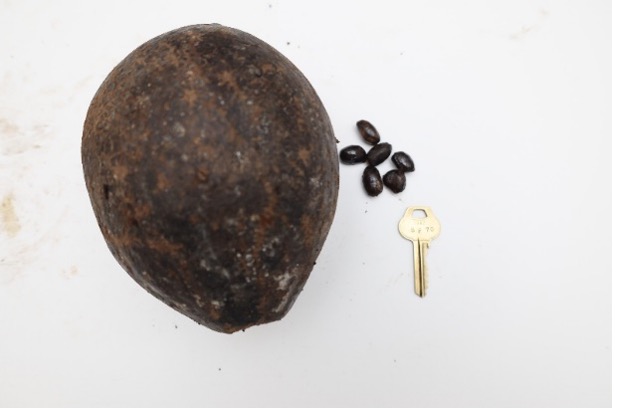
Fruits/seeds: Large, globose, woody fruit (10–20 cm in diameter) resembling a calabash, contains many aromatic brown to reddish seeds covered with a fragrant aril, used as a spice like nutmeg.
Fruiting time: April – September.
Seed extraction method: Remove seeds from the pulp.
Type of seed: Orthodox with epigeal germination.
Sowing method: Sow directly.
Sowing medium: Forest topsoil and composted sawdust.
Germination period: 7-14 days
Germination percentage: 75% (75/100 x 100)
Planting: Requires partial shade at early stage
Growth and development: A medium to large evergreen tree, up to 35 m tall, growth is relatively fast in fertile soil, begins fruiting in 6–10 years under natural conditions.
Notes: Values as a culinary spice and for traditional medicinal uses.